A Decade in Honor of Alan Kulwicki: The Kulwicki Driver Development Program
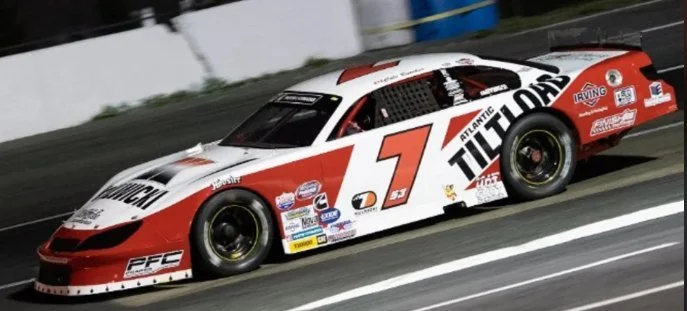
2-Time KDDP Finalist Cole Butcher in a #7 Alan Kulwicki Tribute Throwback
Originally written September 5th, 2024 - due to a hard drive issue I only very recently was able to recover the audio from the interview to transcribe it; I did add an update at the bottom for 2025 though.
The Kulwicki Driver Development Program (KDDP) is a unique initiative in the world of stock car racing, designed to support young drivers as they work their way up the ranks. Named after the late Alan Kulwicki, a NASCAR champion known for his independent spirit and engineering expertise, the program is more than just a traditional driver development initiative. It places a strong emphasis not only on on-track performance but also on off-track responsibilities, including public relations, community engagement, and overall character development.
Key Aspects of the KDDP:
Selection Process:
Each year, a panel selects a group of drivers (usually seven) from across North America to participate in the program. These drivers are chosen based on their racing talent, academic achievements, and character.
Financial Support:
Participants receive financial assistance to help with racing expenses. The KDDP provides funding that can be crucial for young drivers competing in short-track racing series, where budgets are often tight.
Mentorship:
The program offers mentorship from industry veterans who guide the drivers in various aspects of their careers. This includes not only driving advice but also insights into marketing, sponsorships, and media relations.
Community Involvement:
Drivers are encouraged to give back to their communities, a principle that Alan Kulwicki strongly believed in. This includes participating in charity events, working with local organizations, and using their platform to make a positive impact.
The Kulwicki Cup:
The highlight of the program is the competition for the Kulwicki Cup, awarded to the driver who best embodies the spirit of Alan Kulwicki. Points are awarded based on a driver’s best 15 race finishes, community involvement, and how well drivers represent the program and its values. The winner receives a significant cash prize and the honor of being the Kulwicki Cup Champion.
Annual Operational Timeline:
The KDDP operates on a structured annual timeline, beginning with the review of applications in January and culminating with the announcement of the Kulwicki Cup Champion in November. This includes key events such as the selection of semifinalists and finalists, distribution of KDDP decals and wearables, and multiple rounds of judging throughout the racing season.
Alumni Success:
Several KDDP alumni including Wisconsin’s Ty Majeski have gone on to have successful careers in motorsports, making the program a respected and coveted opportunity for aspiring racers.
2024 Kulwicki Cup Champion:
In late November 2024, 15-year-old Ty Fredrickson from Webster, Minnesota, was announced as the youngest Kulwicki Cup Champion in the program's history. Throughout the season, Fredrickson demonstrated exceptional talent and dedication, securing 10 wins, 23 top-five finishes, and 29 top-10s in 36 races. His achievements also include winning the 2024 TUNDRA Super Late Model Series Championship and earning the ASA Midwest Tour Rookie of the Year Award. Beyond his on-track success, Fredrickson was commended for his community service efforts and effective use of social media, embodying the holistic development that the KDDP strives to promote.
The KDDP continues to honor Alan Kulwicki's legacy by fostering the growth of young drivers who not only excel in racing but also contribute positively to their communities and the sport as a whole.
2025 Season Updates/Format:
Restructured format / fewer finalists: For 2025, the program shifted under a restructured format: only five finalists will compete in the full-season Kulwicki Cup competition.
Stipend / services package: Each finalist receives $7,000 (in monies, goods, and services) to assist with the season.
Prize pool layout: The top three finishers will divide a $30,000 pool (monies, goods, and services) by season’s end.
Minimum race requirement: Finalists must enter at least 14 races during the season.
Judging criteria: In addition to race performance, drivers are judged on civic participation, program promotion, fan engagement, and stewardship of Kulwicki’s legacy.
Semifinal stage: The selection process now includes a semifinal round: 13 semifinalists were announced in February 2025, from which the final five finalists were selected.
Timeline & announcements: The application window, semifinal announcements, and finalist reveal were moved to earlier in the year to align with the restructured format.
2025 KDDP “Wild Card” Rule
Program Introduction: The 2025 season introduced a new strategic element called Wild Card Races.
Allocation: Each of the five finalists receives five Wild Cards to use during the season.
Usage Rules: To activate a Wild Card, the finalist must publicly declare it on social media prior to the race weekend.
Impact: When used, the Wild Card allows that race’s performance to count for double points in the Kulwicki Cup standings.
Interview with Recently Retired KDDP Executive Director Tom Roberts [note that this interview was conducted in Sept. 2024, near the end of his last season before retirement]
Me:
From information you sent me and what's already on your website, a lot of the general stuff is already out there. But a few things I was wondering about:
The first one is, hypothetically, if I were a driver and I was eager to participate in the program, how would I go about starting to do that?
Tom:
Our application process actually began in December. We've tried to start in the middle of November and it may very well be that we're able to do that this time around. But generally, by December 1st, the application is available. And we started, I want to say, maybe three years ago, doing all the application process online. So this time around, there would be a link that would be available on the website, https://www.kulwickiddp.com/, as well as I'm thinking that Jeff will also put the link on our social media presence, too. So 12-1-24 application period should be open for the 2025 program. And again, everything is done online.
Me:
And could you walk me through the selection process a bit? Like, what specific qualities or achievements do you look for in a candidate?
Tom:
Well, you know, through the years, with the program originating from funding by Alan's stepmother, Selma, we look at, well, first of all, all super late model, pro late model, late model stock car, asphalt competitors - they are all eligible to apply. And one of the qualities that we are looking for is somebody that the panel deems maybe a young, inspiring version of Alan Kulwicki.
It's sort of loose-ended. And what transpires during the selection process pretty much comes up with just that. After we get all the applications, our judging panel goes through and decides by the different traits there as to: needs, already showing potential, and they actually review the driver's social media sites to get more and more information about them; In an effort to come up with their 15 semifinalists.
So then when the 15 semifinalists are determined, we go through a process. It used to be, I want to say, until two or three years ago that it was simply done as a phone recorded interview. Anyhow, it was, when you think about today's standards and everything, pretty antiquated. But each one of the 15 drivers would have interview slots to come on with a group call with our voting panel. And that's the way the interviews were done. Well, three years ago, we started doing Zoom calls [live audio/video meeting on a digital device]. So everything is done via Zoom now - the interviews are for the top 15. And then the judging panel pretty much all of the time, have the difficult task of choosing only seven drivers of those 15 semifinalists to become finalists. Usually the semifinalists are chosen by the middle of February. The finalists are determined by the middle of March because the seven months of competition itself begins every year annually on April the 1st, and it concludes on October the 31st. So that's pretty much it a nutshell as far as how you go about applying, what the process is, and how we determine the top 15 semifinalists. And then how we come up with our seven finalists.
Me:
This might be a little bit general or kind of case by case different, but, what advice do you think you might give to a young driver who's interested in applying, but say they don't end up getting chosen, like, I don't know, say it's a 15 year old Pro Late Model driver who doesn't end up being selected because they may not yet meet all of the criteria. Is there advice that you could think of for things that would be ideal to focus on?
Tom:
Pretty much, yes. Keep up with the program, hone your skills, and don't ever give up. We've had, I'm gonna say, maybe 20-30% or so of our competitors who either didn't get chosen, even for a semifinalist status, and then come back and apply and get chosen for seven in another year.
There's several that went through that were semifinalists, and never made it to finalists. And there are several who did make semifinalist status and came back the next year and were chosen as finalists. The thing about it is, as you will know, you have to get attention, you have to get on people's radar.
And that is step number one. We've had so many kids that have been, pretty much emotional just to get chosen as a semifinalist. And it's something that they have actually used in self-promotion, that they were a semifinalist.
Then, of course, the next step would be to keep honing your skills, and to show improvement on and off the track. And give it another shot the next year. And, like I said, once these kids reach a semifinalist status, they're on everybody's radar.
And even though they're not competing for the Kulwicki Cup, we know who they are. And we may not be as close as we are with our finalists, but, we do follow them. We do keep up with them. And during our many meetings here in the course of the season, among our judging panel, there's a lot of active discussions about the semifinalists - keeping up with how they're performing, etc.
And it's still a way that they can benefit, if you've gotten people's attention, and you continue to improve during that particular season, well, you've pretty much got a head start if you want to apply for the next season.
Me:
Do you have anything that comes to mind as far as some of the biggest challenges that the organization has faced in its mission to support young drivers? And how do you feel that the organization has done at the goal of helping to support aspiring drivers in the mold of Kulwicki?
Tom:
Well, for us personally, our organization, we were established with funding from the Kulwicki estate. And it's been quite amazing that we've been around for 10 years.
I think it's definitely a compliment to our financial staff who had taken the funds that were donated by Thelma Kulwicki and made the most of them and their investments and all.
Because as we're talking right now, we've not had any additional funding, nothing substantial. For the last two years, especially like now, we're in a complete effort trying to find a presenting sponsor or sponsors that will help us continue this program moving on. That's not saying that we're not solid. We're solid, you know, just to level with you. I think we're solid right now for at least another couple of years.
But I guess my point when I say that is that you and I are talking about a program that you've heard about. Most everybody in North America has heard about. I think we've certainly shown what we can do. And even through the pandemic, of course, we were off. We did not have a class in 2020. But we came back in 2021 just as strong as ever. It seems like we even build up more and more credibility each and every day as we go.
So with that said, I think we've established ourselves. But, you know, we certainly could be a viable target for someone or a company who is looking for what we do and attach their name to it and grow with us to the next level.
I look back and I think of all the different drivers, this would make just shy of 50. And then with the stipends and everything in there, we're well over $900,000 that we've contributed in, in stipends and awards. And you can't really put a figure on what all our drivers, have done as far as their fundraising and their community service.
The kind of exposure that they have gotten, not only for themselves, but, certainly for the program. And a lot of it has to do with success, you know, success on and off the track by all these kids. When I think back about, you know, just this past weekend, it's been amazing. I'm a big Alabama football fan. I've had season tickets. So I'm actually sitting in the grandstand at Bryant-Denny Stadium for the season opener on Saturday night. Through modern technology and all of the racing apps and everything that are available, I'm actually sitting in my seats and I'm watching the ASA Midwest tour event from Dells Raceway track watching Max Kahler take his first career series win - and in dominant fashion, too. And we had just come off of Derek Gluchacki who had won at the big pack race, you know, at Oxford Plains two weeks ago. Then he won again at Waterford.
So I was walking on a trail on Monday and I was listening to the, the Tundra series finale from Golden Sands. And, you know, you see Ty Fredrickson finishing fourth and this young kid, 15, not only wins the Rookie of the Year, but he wins the Tundra championship. So just in the matter of a weekend, we see these drivers excel and succeed that much. Sometimes I just have to stop and think, and appreciate what we have going on here. Great drivers performing on the track - you know, you follow a lot of them - you see what they do.
Me:
Yes! Like, just to add: Levon Vandergeese and Chase Burda, both of them are doing great this year. That's so neat that you can watch them all, too.
Tom:
Yes, and then you see the qualities that these kids possess. There's so many that are independent. They don't come from, you know, all that significant funding. You see that aspect. You see kids that are really hands-on as far as working on their cars. You see kids that have their similar educational backgrounds. You know, you mentioned Levon. Levon actually went to, or is going to the University of Wisconsin in Milwaukee in an effort to get his engineering scholarship. Max Kahler is attending school also in an effort to get his engineering.
For me personally, it all came about a time that I had done NASCAR, racetracks, working with drivers, teams, Rusty for 16 years. Bobby Allison until he got hurt, Alan throughout his career, Kurt Busch for six years. I think 2012 was my last year on the circuit. Pretty much with Penske, it was either, I move to Charlotte and continued my career working with Penske. My late wife and I really didn't want to up and move from my hometown in Alabama.
After more than a decade of living in Atlanta, living in Nashville, we were back home. She was working for the state health department and the last thing I wanted to do was up and move. Roger Penske understood, and they paid me. I didn't have to work for two years. And as it would turn out, it was a blessing for me because I never did think that during that two-year period that my wife would be diagnosed with cancer and then pass away due to cancer in 2016. So, it allowed us to really have two great, great years.
From a professional standpoint, it was during the latter part of that, 2014, that Thelma Kulwicki and her financial people came to me. They told me what they had planned, even though there really wasn't anything definitive mapped out on the board yet; they wanted to do something for Alan and to continue Alan's memory. They essentially gave me a blank sheet of canvas. So I construed the number seven theme, and coming up with the stipends and seven drivers and seven months. For me, and at the time, it was a wonderful opportunity to continue a career in racing in this manner. And I'll always be so appreciative for everything that has transpired.
My wife and I did not have children. It was due to my living, living out on the road, the nomadic circus life, so to speak, that is NASCAR racing, you know, on the road 40 weeks a year, whatever. But, you know, I'm blessed again, and I take personal interest - in our drivers, our finalists, and very much so, these drivers become like my nephews and nieces. And it's like their families are my extended families. I try to work on developing a great relationship with all of these kids - not just business, but a personal one, as well.
I've been truly blessed. And sometimes I have to kind of stop and pinch myself just thinking about seeing these kids improve through the years. And see someone like a Ty Majeski. I go to look back at the pictures of when he was in the photos of when he was in the program in 2015.
Me:
Hah, he looks like a little child now looking back, compared to now.
Tom:
Oh my goodness, yes. I often kid when people when ask me: do you miss being on the NASCAR Cup circuit? I miss the people. But I don't miss that kind of travel. You know, when you're doing 40 weeks a year by the time you do all of the races and special events, not to mention all of the marketing activities we had, like, back during the Miller Days. You've got to love the hotel points and the airline miles. But you develop an attitude, sooner or later, you get the attitude of: oh, goodness, do I have to go there? It's almost a have to feeling.
My method of operating these days is that each driver in our program: I try to take a trip to watch them live and to cheer them on live. And with that, I'm just so eager. I get to go to seven big short track racing events during the year. I get to go and meet them personally and cheer for them. And if you go back and you look even just at this year, I had the privilege of being out in Wenatchee, Washington to see Evan Goetz win that big race.
Me:
Yeah, he's been doing great out in the Northwest too.
Tom:
Yup! And then Derek Gluchacki and being able to be there for his big win at Oxford a couple of weeks ago. I used to really get thrilled to be working with Rusty or Alan when they won races, and get to go to victory lane, and get to work with them. And now I get that same kind of feeling when I see our guys win races. Who would have ever thought we would still see something that Alan Kulwicki created in 1988 with the Polish victory lap? To still be so prominent in such a big way for major celebrations today.
Me:
How many times has Bubba Pollard done one by now? And Majeski
Tom:
Oh, my goodness.
Me:
Between the two of them alone. That's probably 200 plus Polish victory laps.
[Commentary on Cole Butcher & Maritime Canada/Maritime Racing]
Tom:
I have to say that one of the best representatives that we have ever had so far, was Cole Butcher, and his family. And I think they were responsible for taking us to another level. Who would have ever thought we would have one of our finalists, not just one year, but two years that hailed from Nova Scotia. And he carried our colors so well there. And then, to see him progress, expand, come to the U.S., and do what he's done running in the Supers. That has been a tremendous feeling because I really got to know Cole and his mom, dad and brother, the family, and the whole bunch up there very well. And we all keep in touch to this day, a lot of texting.
I had two or three trips that I was able to do to come up there and spend some time with him and see him race at Scotia Speedworld. Not only was it great business, but it really is such great personal memories. I always think the world of them, and they know that.
Me:
I remember still when Cole was part of the program, just seeing all of the stuff, like fundraising stuff, things with kids, just all the activism and stuff like that he was doing. I'll tell you still to this day in the Butcher Racing shop there, there's Kulwicki Driver Development Program number seven, decals and stickers around the shop still.
Tom:
You know, he did at least one, maybe two great throwback color schemes. And I was blessed to be there for his back-to-back Oxford 250 wins. There will always be a warm spot in my heart for Nova Scotia, for the Maritimes, and the racing that is done up there. You know, even though we don't have a driver in our program, now I still try to keep up with what's going on up there. Not to mention enjoying Halifax, spending time there. It's a great town, I love that area. You know, I think that there are a lot of people in the States that don't really understand just how beautiful that area of the world is.
Me:
I have a question, too, about the stipend of $7,777. So, $7,777 to each selected driver. Is there any kind of guidelines or expectations in place for how the stipend should be utilized?
Tom:
Yeah, as a matter of fact, we do pretty much mandate that they provide how they spend it. Our suggestion, of course, is to utilize it for operational expenses. You know: tires, gas, pit passes, travel. It's very easy for these kids, for what they're faced with, to legitimize their expenses. We try to divide it in half. We give them, you know, half during the first half of the year and give them the second half, second half of the year. Just try to keep a constant flow there. But to this day, we've never had any kind of problems whatsoever with any of the drivers earning their stipend money.
When I was formulating the program and all of the basics, it was natural instinct to go with the the number 7, Alan's number, to come up with a figure of $7,777 as far as the stipend that goes to each of the finalists. But when it came to formulating the grand prize, most everyone would think that the next extension of the number 7 would be making that $77,777. Well, I'm thinking, wow, there are many, many racing series championships that would not even come close to paying their champion that kind of money.
So I think with my close friendship and knowledge of the way that Alan operated, that's what led me to decide that we don't have to do the $77,777. Our natural extension will be 7 times the stipend. So instead of it being 77,777 it's 54,000 and some change, but it is an extension of the 7,777. And yet we've accomplished our goal there, but we've also saved considerable dollars. That's just the way that Alan would have operated. And I had a huge smile on my face when I came up with that, because I said that, you know, Alan would be proud of me. That is also extra money that can be applied to funding our annual banquet.
Our annual banquet is an absolute feat. You know, through the years, all of the guest speakers, we're still working on trying to figure out who we're going to try to get for this season. Having a Rusty, Kyle Petty, Mark Martin, and Kurt. Every year we've had these guys that are so into what we're doing, and so much personal respect that they had/have for Alan and his memory, that they have volunteered.
I have not paid a dime for any of our speakers to come and talk to these kids. And to have it broadcast like we've had via either Speed 51 or Racing America, everybody can enjoy it. And it's not only a big night that we bring the kids in, it's like two days. What we've been doing has been doing a go-kart competition for them the night before the banquet. And in addition, they all are competitive, they all want to win. But it's a wonderful way for them to get to know each other and share time together, have a fun outing. And then we always do fun things like shop tours. We've done Penske, Stuart Haas. We went to the Ford Engineering Center. We've been to NASCAR Hall of Fame. We've been to the Kulwicki Lab at UNCC. So it's a fun couple of days that these kids get. It's like a payback for a wonderful season of representing Alan and the organization when we all do gather in Charlotte in December.
[Commentary on Cole Butcher]
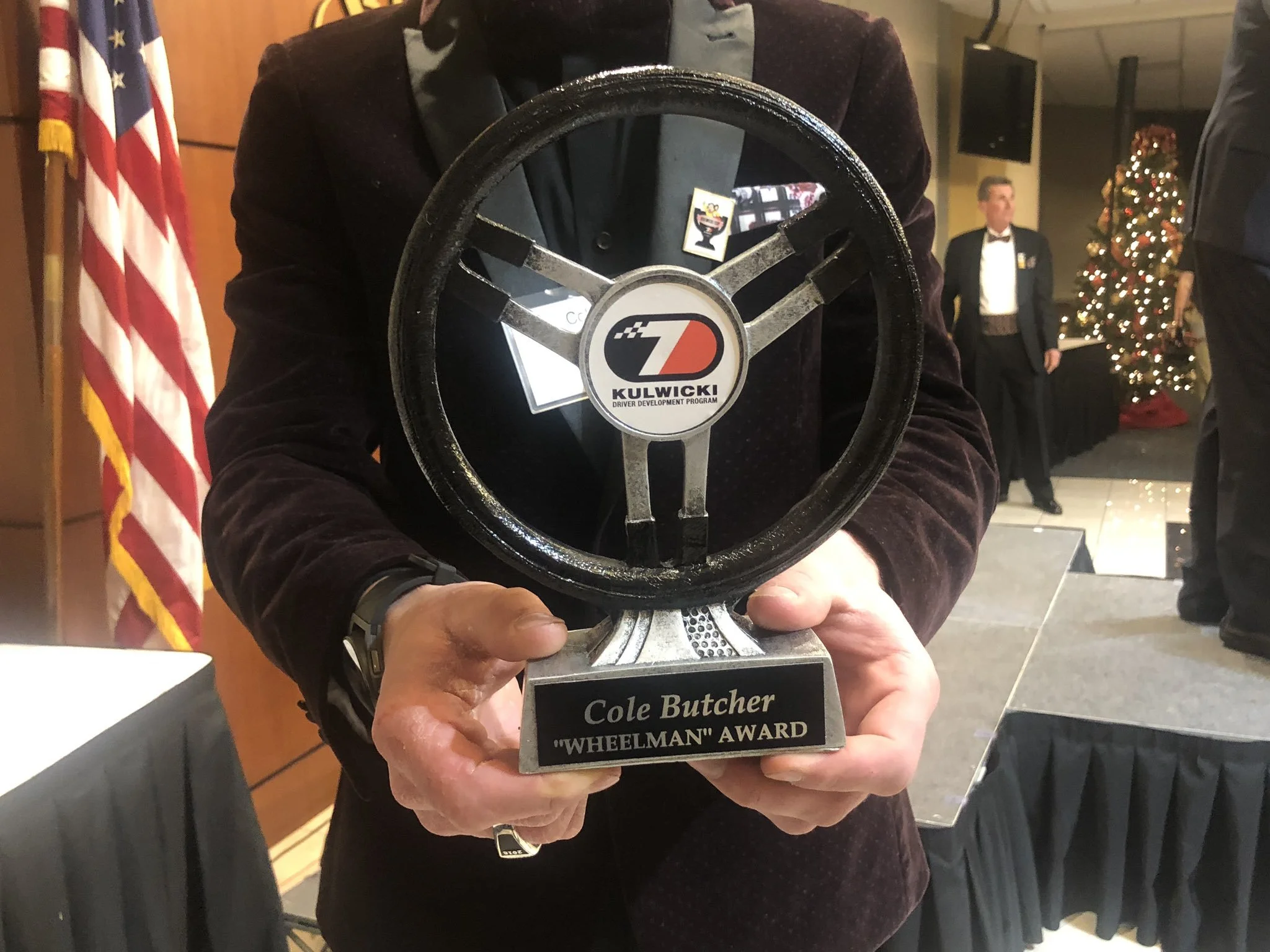
Cole Butcher was a two-time finalist in the program, and to this day, he is the lone recipient of what we called the Wheelman Award. Cole came on so strong. He never did win the Kulwicki Cup, but he came on so strong one year. He feel behind behind, but he came on so strong to finish up third in the points. He drove his heart out, and started winning all these races. And all of our judging panel said: golly, if he could have only done that the whole year, he'd have won the Kulwicki Cup. So, they all felt almost obligated, but they couldn't give him the Kulwicki Cup: But he certainly earned something.
So, they came up with the Wheelman Award. And to this day, he's the only one that's ever won the Wheelman Award.
Me:
I have one more question for you here. How do you match drivers with mentors? And what qualities do you look for in a mentor within the organization?
Tom:
We don't particularly have a specific process for matching any driver with their mentors. But what's been so heartwarming for us is to see how all of these drivers have become mentors to younger racers. And that has been a lot, it's not just one or two. It seems like every year it happens, and it began with Majeski. He went on after winning to start his own driver development program with young go-kart drivers. That's what's been most impressive, I think, to me. Is seeing them, not only are they growing during their competition for the Kulwicki Cup, but they also have young drivers that look up to them. And they become mentors for an even younger generation of drivers.